
Information Processing in the Cell Nucleus
The human genome presents a fascinating puzzle: it contains around 20,000 protein-coding genes, however, nearly one million regulatory elements control when and how these genes are expressed. This disparity raises intriguing questions about how such a limited number of genes can lead to the vast diversity of cell types and functions in complex organisms. At the Institute of Biological and Chemical Systems – Biological Information Processing (IBCS-BIP) at Karlsruhe Institute of Technology (KIT), we attempt to answer these questions by studying the processing of genomic information in the cell nucleus. Our research profits from the use of zebrafish as a model for how the genetic code controls embryonic development and a panel of inbred medaka fish lines as a model for how genetic diversity encodes phenotype differences in a natural population. We also dissect the mechanistic underpinnings of how gene regulatory elements control the read-out of specific genes, and venture into creating synthetic DNA-sequence-programmable materials that mimic the natural control of gene read-out. By understanding how living systems store and process information, we hope to discover innovative approaches towards bio-inspired materials and technologies for information processing, ultimately benefiting fields such as biotechnology and medicine.
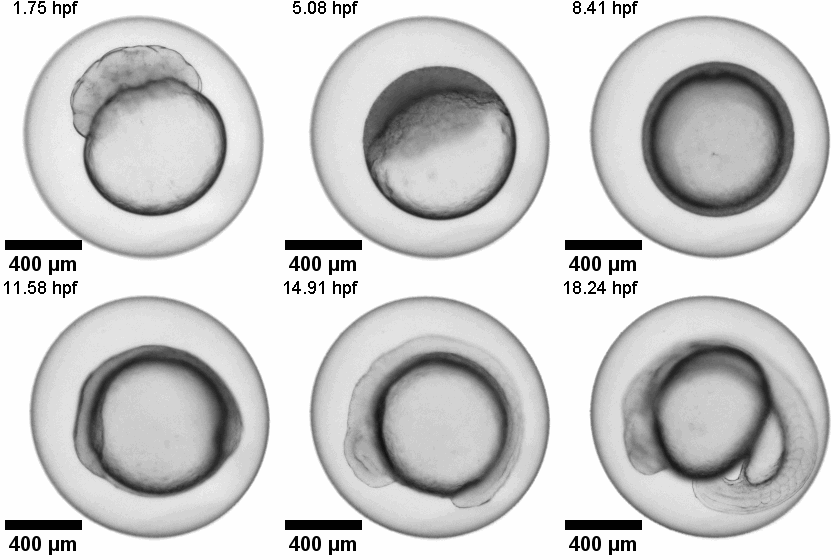
Decoding the Zebrafish Genome
“The DANIO-CODE consortium has identified over 140,000 cis-regulatory elements that control gene transcription throughout zebrafish development.”
A significant achievement in understanding nuclear information storage has been our contribution to the DANIO-CODE consortium, which established a centralized repository for zebrafish developmental genomic data. This collaborative effort has resulted in a comprehensive resource containing 1,802 sets of genomic data, including both unpublished and re-analyzed published information [1]. This repository has proven invaluable for improving existing annotations and demonstrating their practical value in experimental design.
Key findings from this work include:
- Identification of over 140,000 cis-regulatory elements that control gene transcription throughout zebrafish development.
- Mapping of unique chromatin and spatial topologies between regulatory elements active during early zygotic genome activation and those active later in organogenesis.
- Alignment of regulatory elements and epigenomic landscapes between zebrafish and mouse, revealing functional relationships beyond simple sequence similarity.
These insights provide a deeper understanding of how genetic information is organized and accessed during vertebrate development, offering potential applications in both basic research and biomedical studies.
[1] Baranasic D, Hörtenhuber M, Balwierz PJ, et al. Multiomic atlas with functional stratification and developmental dynamics of zebrafish cis-regulatory elements. Nature Genetics 54, 1037–1050 (2022). https://doi.org/10.1038/s41588-022-01089-w
Exploring Genotype-Phenotype Relationships
Building upon the genomic insights gained from zebrafish studies, we have established a panel of medaka inbred strains to further investigate the genetic basis of natural trait variation in vertebrates. The establishment of a panel of 80 medaka inbred strains from a wild medaka population, a task requiring more than 6 years and 2000 crosses, has resulted in each line serving as a “snap shot” of genetic variability in that wild population. Given that the genome sequence is available for each line, genome-wide association studies allow us to explore the genetic underpinnings of various complex traits.
Initial studies focused on resting heart rate—a well-established predictor of overall mortality. Using wide-field microscopy, we quantified embryonic heart rate variations between strains. Subsequent genotype-phenotype association studies identified several genomic regions associated with heart rate frequency, including genes linked to heart development and organ maintenance.
This medaka inbred panel represents a powerful resource for future studies on the genetic basis of various complex traits and diseases, potentially leading to new insight in developmental biology and personalized medicine.