
Understanding tissue organization
The development and function of tissues and organs are governed by intricate spatial and temporal processes that integrate genetic, mechanical, and environmental cues. At the Institute of Biological and Chemical Systems (IBCS-BIP) at Karlsruhe Institute of Technology (KIT), we investigate how these factors shape the organization and behavior of cells within three-dimensional (3D) tissues. By combining advanced imaging, mechanobiology, and interdisciplinary approaches, we aim to uncover fundamental principles of tissue development and create innovative applications in regenerative medicine and biotechnology.
Decoding Tissue Organization
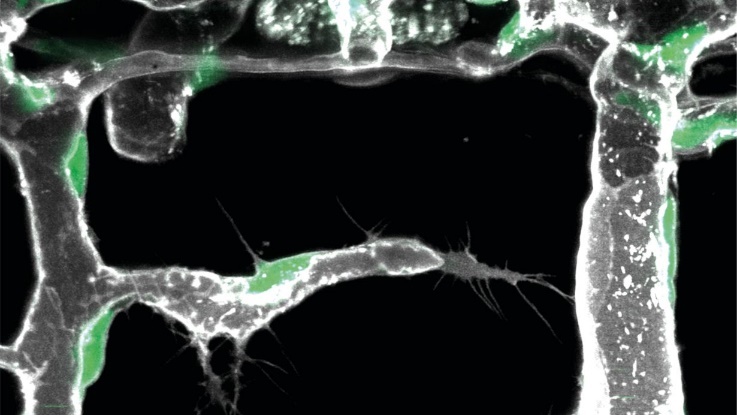
Green indicates endothelial cell nucleus, grey the outline of the blood vessels.
"Our discovery of 'pioneer cells' in organ-specific blood vessel branching reveals how unique vascular patterns develop, opening new avenues for targeted therapies in cardiovascular diseases and cancer."
Our research explores how cells self-organize into complex tissues during development. Using zebrafish and medaka as model organisms, we study the genetic and mechanical factors that guide tissue formation:
- Vascularization: We identified a novel vascular cell type, "pioneer cells," which play a critical role in organ-specific blood vessel branching. These cells respond to molecular signals from surrounding tissues, initiating vascular growth at precise locations. By decoding these molecular cues through single-cell sequencing and bioinformatics, we aim to develop therapeutic strategies for cardiovascular diseases and cancer [1].
- Scaling in Development: Through developmental quantitative trait loci (devQTL) mapping in medaka, we revealed mechanisms that link developmental timing to organismal size. This work highlights how spatial scaling during embryogenesis is controlled by distinct genetic modules governing segmentation timing and tissue size [2].
References
[1] Parenchymal cues define Vegfa-driven venous angiogenesis by activating a sprouting competent venous endothelial subtype. Laetitia Préau, Anna Lischke, Melanie Merkel, Neslihan Oegel, Maria Weissenbruch, Andria Michael, Hongryeol Park, Dietmar Gradl, Christian Kupatt, Ferdinand le Noble. Nature Communications 15:3118 (2024)
[2] Modular control of vertebrate axis segmentation in time and space. Ali Seleit, Ian Brettell, Tomas Fitzgerald, Carina Vibe, Felix Loosli, Joachim Wittbrodt, Kiyoshi Naruse, Ewan Birney, Alexander Aulehla. EMBO Journal 43:4068-4091 2024